

By Hannatu Suleiman Abba
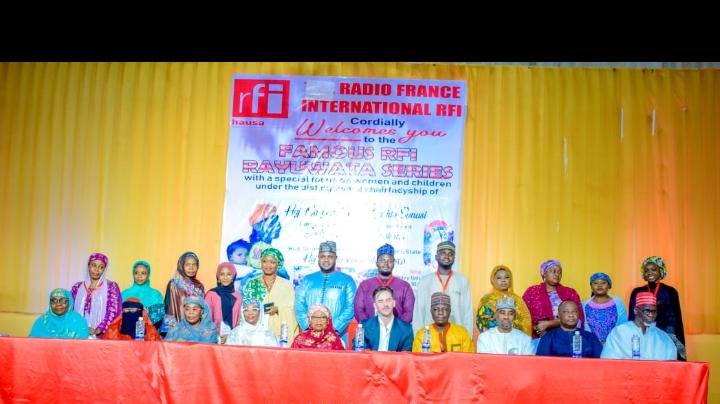
On May 16, 2026, Kano State witnessed a remarkable gathering that bridged conversations around women’s representation during the famous “Rayuwata” series organised by Radio France Internationale.
Women in Northern Nigeria continue to play a critical role in the socio-religious and cultural development of society.
Through the “Rayuwata” series, RFI has created a platform that highlights the resilience, talents, and contributions of women while respecting the region’s religious and cultural values.
Many women across Northern Nigeria are now reaching new milestones, pursuing their dreams, and showcasing their talents in ways that align with their traditions and beliefs.
In many households across Hausaland, radio remains one of the most influential tools for education, information, and entertainment for both men and women.
The history of radio in Northern Nigeria is closely tied to the development of broadcasting in Nigeria itself. Radio became a powerful medium for communication, education, culture, and politics because it reached millions of people through the Hausa language.
Radio broadcasting in Nigeria began in 1933 during British colonial rule through the Radio Distribution System (RDS), which mainly relayed programmes from the BBC in London.
Initially, broadcasts were transmitted through wired loudspeakers placed in public spaces.
By the 1940s, radio stations gradually spread across different parts of Nigeria, including Northern Nigeria, with Kano receiving one of the early relay stations around 1944.
Over time, Hausa became one of the strongest languages in African radio broadcasting, attracting international broadcasters whose programmes gained popularity across Northern Nigeria and neighbouring countries.
With the emergence of private radio stations across Northern Nigeria, women gained more opportunities to stay informed and engaged in public discourse.
However, women’s voices were often limited when it came to religious expression and cultural narratives.
Many media platforms overlooked stories of women whose experiences deserved attention, especially those preserving traditional businesses and indigenous crafts.
The “Rayuwata” series by RFI has introduced a new dimension of human-angle storytelling that tells Northern Nigerian stories through the voices of Northerners themselves.
The programme is more than just a media series; it is a lasting platform that documents untold stories of women who proudly uphold their religion and culture while contributing meaningfully to society.
Promoting Religion and Culture with Pride
The “Rayuwata” series has created an avenue for portraying the realities of Northern Nigerian life through the lens of religion and culture.
Through hundreds of reports, the programme has demonstrated how journalists can play a significant role in amplifying women’s voices in Northern Nigeria. Each episode highlights women’s hard work, resilience, and commitment within their communities.
From women who inherited traditional barbing salons (wanzanci) to those producing mats from local materials, the series showcases indigenous businesses that have survived for generations and are now gaining wider visibility, including on social media.
Most importantly, many of the women featured continue to advocate for stronger representation and greater inclusion of women’s voices in the media.
Media Advocacy for Women’s Voices
The “Rayuwata” series has also drawn the attention of critical stakeholders to the realities facing vulnerable women in society. Beyond showcasing women’s skills and resilience, the programme highlights issues affecting women and the need for greater social and economic support.
Kano State Commissioner for Women Affairs, Amina Sani, commended RFI for promoting human-centred stories that provide deeper insight into women’s lives and efforts to reduce poverty in Kano State.
According to her, collaboration between the “Rayuwata” team and the Kano State Ministry of Women Affairs could further strengthen stories addressing the challenges women face and government efforts aimed at addressing them.
She noted that the series has exposed the important contributions women make within their communities and highlighted the need to support them more effectively.
Religion and the Call for Change
The Kano State Hisbah Board has long played a role in protecting women and children under Shari’a law.
The “Rayuwata” series also highlights the contributions of women to entrepreneurship and economic development within Islam.
Deputy Commander of Hisbah, Khadija Sagir, explained that the first wife of Prophet Muhammad (S.A.W), Nana Khadija, was a successful businesswoman who devoted much of her wealth to the development of Islam.
She stressed that Islam encourages women to contribute positively to economic growth, seek knowledge, and pursue justice within acceptable moral principles.
“The voices of women deserve to be heard, and Islam permits this when done in a righteous manner,” she said.
Traditional Institutions and Social Change
Speaking on behalf of the wife of the Emir of Kano, Maryam Sanusi Lamido Sanusi, Dr. Maryam Nasir Aliyu of the Women Relief and Empowerment Initiative (W.O.R.E) described the “Rayuwata” series as a reflection of everyday realities in Northern Nigeria.
She acknowledged that women remain vulnerable in many parts of society and noted that the programme demonstrates why women should be empowered, equipped with practical skills, and given platforms to express their views.
According to her, the Kano Emirate remains committed to advocating for positive social change and improved opportunities for women.
Growing Advocacy for Women’s Voices
Participants and advocates who attended the “Rayuwata” event expressed admiration for the programme’s role in changing negative narratives surrounding women in Northern Nigeria.
They noted that the series continues to break barriers by promoting women’s participation in education, entrepreneurship, and community development while respecting religious and cultural values.
In conclusion, I will close with the speech of Radio France Internationale’s Country Director in Nigeria, Mr. Joe Penney, who said that RFI has a large number of listeners and followers in Kano State.
Hausa-language radio has millions of listeners across West Africa.
Estimates show that Hausa is spoken by about 70–100 million people, making it one of the most widely spoken African languages. The “Rayuwata” series is not only making an impact in Nigeria, but also in countries where Hausa-speaking people live, promoting their rich culture and dialect.