

By Musa Abdullahi Sufi
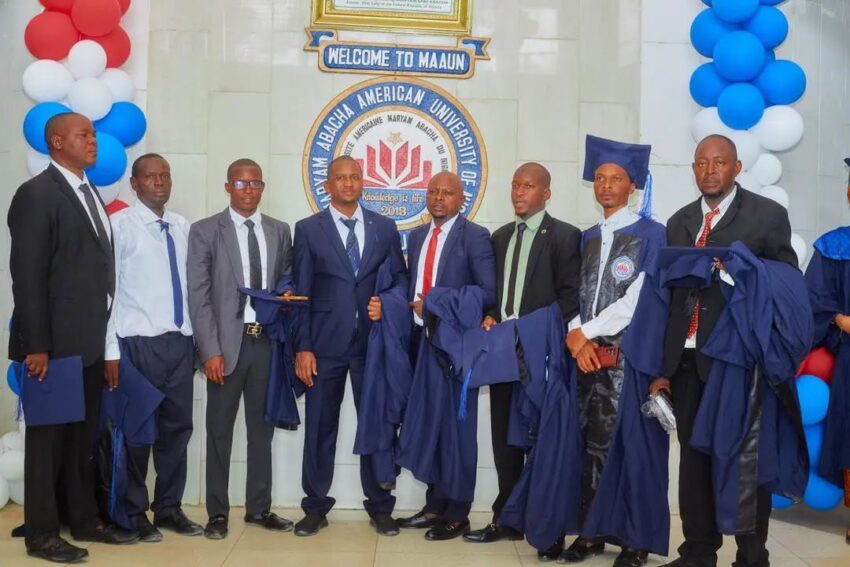
In a defining moment for higher education in Africa and a bold testament to the transformative power of visionary leadership, Maryam Abacha American University of Niger (MAAUN), Maradi, has formally matriculated 430 students for the 2025/2026 academic session; marking not merely the admission of new students, but the strengthening of a continental movement dedicated to innovation, bilingual education, international relevance, and youth empowerment.
This landmark event, held in Maradi, Niger Republic, is far more than a ceremonial rite of passage. It represents a profound statement about the future of Africa, a future where borders no longer limit knowledge, where language becomes a bridge rather than a barrier, and where education is deliberately designed to prepare students for local impact and global competitiveness.
Founded in 2013 as the first bilingual university in Sub-Saharan Africa, MAAUN Niger-Maradi stands today as one of the continent’s most ambitious academic experiments; an institution strategically positioned to redefine education through the fusion of Anglophone and Francophone systems. Thus, creating graduates who are uniquely equipped to thrive in a highly interconnected world.
A Historic Academic Milestone with Continental Significance
The matriculation of 430 students into various undergraduate disciplines across science, humanities, and professional studies is not simply a numerical achievement; it is a reflection of growing trust in a university system that has consistently proven its capacity to combine academic rigor with moral discipline, practical relevance, and international opportunity.
At a time when Africa faces urgent demands for access to quality education, employability, innovation, and regional integration, MAAUN’s expansion offers a strategic solution producing graduates who are academically competent, culturally adaptable, and professionally prepared for the global stage.
Speaking during the matriculation ceremony, the Director-Campus, Dr. Shu’aibu Usman-Tanko, underscored the deeper meaning of matriculation as an academic covenant.
“Matriculation ceremony essentially denotes the formal admission of candidates who are adjudged academically qualified, emotionally stable, and psychologically ready to cope with the rigorous challenges of academic engagement,” he stated.
His message was clear: admission into MAAUN is not simply about enrolment, it is about entering a disciplined intellectual ecosystem where excellence, integrity, and character are non-negotiable.
His charge to students to uphold the institution’s values and avoid misconduct reflects MAAUN’s zero-tolerance stance on indiscipline, a philosophy increasingly rare yet critically needed in modern educational systems.
Beyond Borders: Building Africa’s Educational Diplomacy
What makes MAAUN particularly remarkable is its strategic role in fostering educational diplomacy across Africa.
Situated in Maradi, a vital socio-economic and cultural corridor connecting Niger and Nigeria, the university has become a beacon of transnational collaboration. It is nurturing a new generation of African leaders capable of navigating multiple languages, cultures, and systems.
This model directly aligns with the African Union’s Agenda 2063 vision of an integrated, prosperous, and peaceful Africa driven by its own citizens.
By creating a bilingual educational environment, MAAUN is dismantling one of Africa’s long-standing developmental divides, the linguistic separation between Francophone and Anglophone nations.
In practical terms, this means MAAUN is not only producing graduates; it is producing bridge-builders, policy innovators, healthcare professionals, entrepreneurs, and diplomatic actors who can function seamlessly across regions.
Student Voices Reflect a Growing Global Reputation
Perhaps one of the most compelling endorsements of MAAUN’s impact came not from administrators, but from the students themselves.
Describing the institution as a “conglomerate of universities known for academic excellence,” students highlighted the university’s growing international reputation, especially in health sciences and professional development.
“MAAUN has given us the opportunity to grow. Many MAAUN health science graduates with professional careers are working abroad. The university is breaking barriers and paving the way for a more inclusive and diverse learning environment.” This testimony speaks volumes.
In an era where students and parents increasingly seek institutions that guarantee not only degrees but mobility, employability, and international recognition, MAAUN’s brand is emerging as a serious force.
Its graduates’ presence in global professional spaces signals a university ecosystem intentionally designed to compete beyond local limitations.
Infrastructure as Legacy: A N10 Billion Investment in the Future
The ongoing construction of MAAUN Maradi’s permanent site in Gwarzo town, Djiratawa, with a staggering N10 billion commitment, is another extraordinary indicator of Professor Adamu Abubakar Gwarzo’s long-term educational philosophy. This is not expansion for prestige, it is infrastructure for generational transformation.
Such an investment demonstrates confidence in Africa’s youth and a refusal to accept mediocrity in educational infrastructure. It places MAAUN among a growing class of institutions that understand that world-class learning environments are essential to producing world-class graduates.
Beyond classrooms, this development symbolizes jobs, regional economic growth, innovation ecosystems, and stronger bilateral cooperation between nations.
The Gwarzo Educational Empire: A Model of Pan-African Excellence
MAAUN Maradi is part of a larger educational network under Professor Gwarzo’s visionary leadership, including MAAUN Kano, Nigeria, Franco-British International University (FBIU), Kaduna and Canadian University of Nigeria (CUN), Abuja.
Together, these institutions form an expanding intellectual architecture committed to reshaping Africa’s educational narrative.
Professor Gwarzo’s approach is deeply strategic: build institutions that are not isolated campuses, but ecosystems of opportunity where innovation, leadership, diversity, and global citizenship intersect. His educational investments reveal a philosophy rooted in one powerful truth: Africa’s greatest wealth is its human capital.
Why This Moment Matters Globally
Globally, universities are increasingly judged by their capacity to foster inclusion, innovation, employability, and international partnerships. MAAUN’s model resonates because it addresses several urgent global priorities among them include:
1- Cross-cultural understanding
2- Access to quality education
3- Youth empowerment
4- Research and innovation
5- Gender inclusion
6- Regional peace through educational cooperation
As geopolitical tensions and economic inequalities challenge young people worldwide, institutions like MAAUN offer a compelling counter-narrative: education as a force for unity, dignity, and sustainable development.
A Call to Africa and the World
The matriculation of 430 students at MAAUN Niger-Maradi should not be seen as an isolated institutional event, it is a continental statement.
It is proof that African-led educational institutions can compete globally, inspire locally, and transform internationally. Also for students, it offers hope, for parents give confidence, for policymakers it reflects a model and for Africa, it is a blueprint.
Professor Adamu Abubakar Gwarzo’s vision deserves not only recognition but strategic support from governments, development agencies, international partners, and communities committed to the future of education.
Conclusion: The Dawn of a New Educational Era
As the 430 newly matriculated students begin their academic journey, they do so not merely as undergraduates, but as participants in one of Africa’s most compelling educational revolutions.
MAAUN is more than a university.
It is a movement, a bridge, a vision and a continental force shaping minds for global relevance.
In Professor Gwarzo’s dream, education is not confined by geography, it is a passport to possibility. And in Maradi today, that passport has been placed in the hands of 430 future leaders ready to shape Africa and the world.