

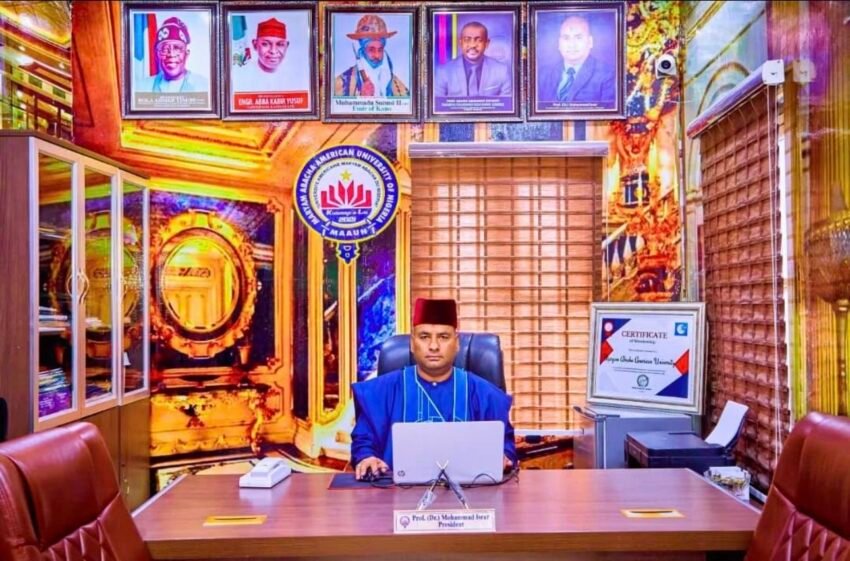
By Mustapha Salisu
The President of Maryam Abacha American University of Nigeria (MAAUN), Prof. Mohammad Israr, has co-authored a research study proposing the integration of Artificial Intelligence (AI), cyber-physical systems and digital twin technology to improve sustainability and efficiency in glass manufacturing.
The study, titled “An Intelligent Cyber-Physical Digital Twin Approach for Sustainable Glass Manufacturing in Smart Manufacturing Environments,” was co-authored with Boby K. George of Lincoln University College, Malaysia.
The research examines how emerging technologies can be integrated into glass production to create a smarter and more environmentally sustainable manufacturing environment under the Industry 5.0 framework.
According to the study, glass manufacturing involves continuous high-temperature operations, making furnace efficiency, material composition and combustion conditions critical factors affecting energy consumption and product quality.
The researchers proposed an architecture linking physical production systems, sensing technologies, real-time data synchronisation, Digital Twins, hybrid AI-physics modelling, multi-objective optimisation and robotic inspection.
The framework identifies eight key process variables, including cullet ratio, fuel flow, air-fuel ratio, excess oxygen, combustion-air temperature, furnace pressure, batch feed rate and glass pull rate.
The study proposes combining data-driven prediction with physics-based energy modelling to enable adaptive learning while keeping manufacturing processes within established physical constraints.
It also identifies cullet, or recycled glass, as an important sustainability variable, noting that published research has reported furnace-energy savings of about 2–3 per cent for every 10 per cent increase in cullet under appropriate conditions.
The researchers said the proposed Digital Twin approach would allow manufacturers to assess interconnected process changes while simultaneously considering energy consumption, carbon dioxide emissions, production flow and product quality.
The study clarified that its illustrative dataset and graph demonstrate the intended analysis workflow and do not represent experimental results, describing the work as a pre-validation study that provides a basis for subsequent implementation and quantitative validation.