

From Tongnaan Bawa Jos
In a state that has experienced years of recurring conflict, the role of the media in shaping public perception and influencing peace efforts has become more critical than ever.
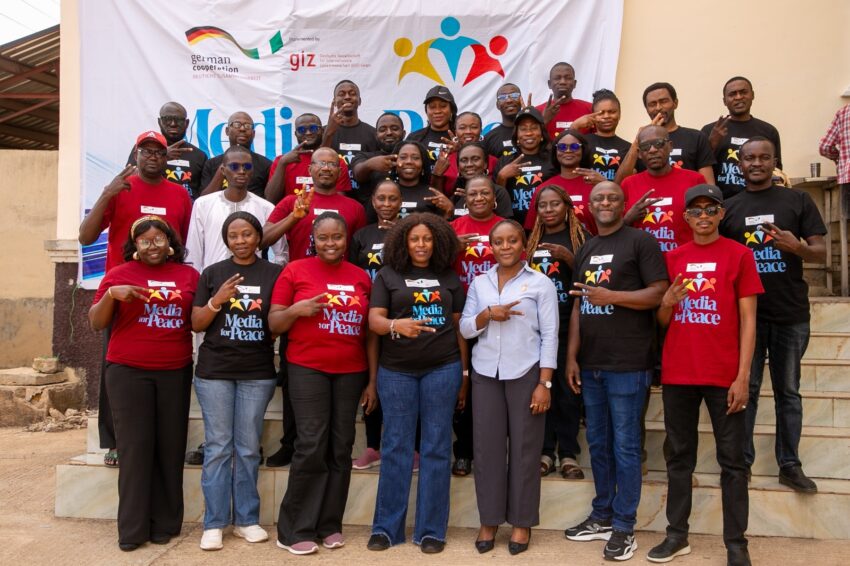
Recognising this responsibility, the Plateau State Peace Building Agency, in partnership with the German Agency for International Cooperation, GIZ, through its PEACECORE Programme, convened journalists in Jos for a three-day intensive training on conflict-sensitive and peace-oriented reporting.
Held at the Crispan Hotel and Suites in Jos, the training brought together reporters, broadcasters, editors, and digital media practitioners from various media organisations across Plateau State.
The programme, tagged “Media for Peace,” was designed as the second cohort of an initiative aimed at strengthening journalists’ capacity to report conflicts responsibly, combat misinformation, and promote peaceful coexistence through accurate and solution-focused journalism.
For many participants, the training was more than a professional exercise. It was a reminder that journalism can either escalate tensions or become a bridge for dialogue and reconciliation.
Speaking during the training, GIZ Senior Technical Adviser, Susan Gopuk, explained that the organisation’s peacebuilding interventions span Plateau, Kaduna, and Taraba States, focusing on vulnerable groups including women, youths, farmers, herders, internally displaced persons, and persons living with disabilities.
According to her, the programme adopts a holistic peacebuilding strategy that combines dialogue facilitation, trauma healing, youth engagement, climate-smart interventions, and institutional strengthening.
“The media plays a critical role in shaping narratives, supporting early warning mechanisms, preventing conflicts, and amplifying peace messages. Our stories must be told by us,” she said.
The training featured sessions on communication for development, information disorder, artificial intelligence and fact-checking tools, digital media, and conflict-sensitive journalism.
Communication specialist, Iren David, who facilitated a session on development communication and peacebuilding, challenged journalists to move beyond sensational headlines and focus on reports that inspire positive social change.
“Stories must connect with the realities of the people. Journalists have a responsibility to promote participation, dialogue, and behavioural change through factual and balanced reporting,” she stated.
Participants also explored the growing dangers of misinformation, disinformation, and hate narratives within the digital media ecosystem. Facilitator, Lois El-Kojonwa Ugbede, described information disorder as one of the biggest threats facing modern journalism.
He explained the distinctions between misinformation, disinformation, and malinformation, warning that false or manipulated content can deepen tensions and trigger violence if not properly verified before publication.
“Information disorder disrupts public trust and can inflame existing conflicts. Journalists must understand the ethical dimensions of information production and ensure credibility through fact-checking,” Ugbede said.
The training also introduced participants to emerging Artificial Intelligence tools and digital verification techniques used to detect manipulated images, videos, and false narratives online. In practical sessions, journalists were divided into groups and tasked with rewriting sensational conflict reports to make them more balanced and peace-oriented.
On his part, Murtala Abdullahi, a confict Researcher who spoke on conflict sensitive Journalism, stressed the importance of understanding the historical, cultural, and structural roots of conflicts before reporting on them.
“Conflict-sensitive journalism requires understanding the context and consequences of every report. Digital platforms shape public narratives, and journalists must use them responsibly to build peace rather than division,” he said.
Participants described the training as timely, especially in an era where social media platforms have accelerated the spread of false information and inflammatory content.
Many journalists at the workshop said the knowledge gained would improve their reporting and help them mentor colleagues within their respective organisations.
The programme ended with renewed calls for sustained collaboration between media practitioners, civil society organisations, and peacebuilding institutions to ensure that journalism continues to serve as a tool for unity, dialogue, and development in Plateau State and beyond.
As the participants departed after three days of learning and reflection, one message resonated strongly throughout the training: in fragile societies, responsible journalism is not just about reporting events, “It is about helping communities find pathways to peace”
They however appreciated the organizers for granting them the opportunity to learn diligently and assured that they would put all knowledge acquired into practice and step it down through mentorship.