

By Hajara Bala Sidi
Every morning, long before official clinic hours begin, patients already crowd the waiting areas of major public hospitals in Kano.
Some arrive before dawn hoping to meet doctors early. Others sit for hours on crowded benches clutching medical cards, test results, and nylon bags containing drugs. Relatives move between corridors searching for empty spaces while exhausted nurses attend to an endless flow of patients.
Across Kano State, growing pressure on public hospitals is exposing deep cracks in Nigeria’s healthcare system from severe doctor shortages and overstretched facilities to rising patient numbers driven by poverty and expensive private healthcare.
An analysis based on publicly available reports, health sector data, and medical association statements shows that Kano’s public hospitals are struggling to cope with increasing demand for healthcare services.
Rising pressure on public hospitals
Kano is Nigeria’s most populous state, with an estimated population exceeding 16 million people. Yet according to the Nigerian Medical Association (NMA) in Kano, the state currently has about 1,800 practicing doctors serving this population.
The figure translates to roughly one doctor for every 12,000 residents, far below the World Health Organization’s recommended ratio of one doctor to 600 patients.
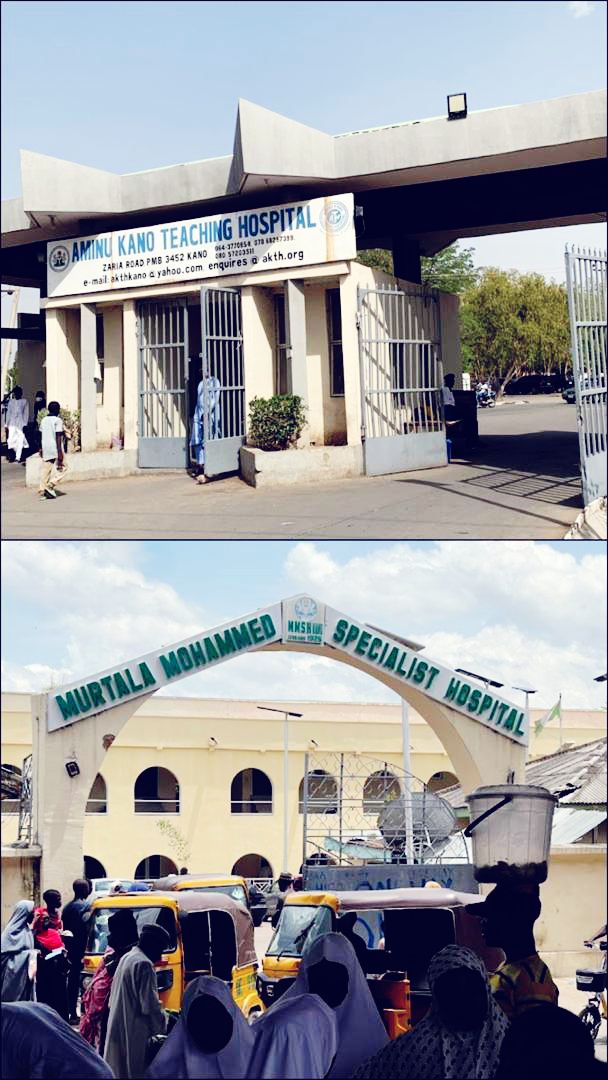
Health experts say the shortage has intensified pressure on major referral facilities such as Murtala Muhammad Specialist Hospital and Aminu Kano Teaching Hospital, which receive patients not only from Kano but also from neighbouring northern states.
Overcrowding becoming routine
At Murtala Muhammad Specialist Hospital, overcrowding has become a daily reality.
In the early hours of one weekday visit, patients could be seen sitting shoulder-to-shoulder in waiting areas, while relatives stood outside wards hoping for updates on loved ones.
A mother of three, Maryam Wada, who brought her feverish child for treatment, described the experience as exhausting.
“We came before 6 a.m., but by midday we had still not seen a doctor. My child was crying the whole time. You just wait and hope nothing gets worse,” she said.
Healthcare analysts say such conditions are becoming increasingly common in urban public hospitals where patient numbers continue rising without a corresponding expansion in infrastructure and staffing.
Healthcare workers under strain
Inside hospitals, medical staff are working under increasing pressure.
A nurse at a major Kano public hospital, who requested anonymity, described the workload as overwhelming.
“Sometimes you are attending to more patients than you can properly handle. You are rushing from one emergency to another. At the end of the day, you go home completely drained,” she said.
The Nigerian Association of Resident Doctors and other health unions have repeatedly raised concerns over burnout, long working hours, and workforce shortages in public hospitals across the country.
Infrastructure and demand gap
Beyond staffing shortages, Kano hospitals also continue to face infrastructure-related challenges, including limited bed space and growing patient inflow.
At Aminu Kano Teaching Hospital, staff and patients frequently describe heavy congestion in emergency and outpatient units, especially during peak hours.
Health experts argue that the gap between population growth and healthcare infrastructure expansion has widened over time, increasing pressure on already stretched facilities.
Human cost of the crisis
For patients, the system often means long waiting hours and uncertainty.
A middle-aged trader who brought his elderly father to hospital described spending nearly an entire day waiting for consultation.
“We got here early morning. By afternoon, we were still waiting. My father was weak, but there was nothing we could do except wait,” he said.
For many low-income residents, public hospitals remain the only affordable option as private healthcare costs continue to rise.
A system under pressure
Nigeria’s rapidly growing population, combined with persistent doctor shortages and under-resourced facilities, continues to place heavy strain on public hospitals in Kano.
While interventions have been announced at various levels of government, health experts say sustained investment in staffing, infrastructure, and primary healthcare systems is essential to reduce pressure on major referral hospitals.
For now, overcrowded wards, long queues, and exhausted health workers remain a daily reality across Kano’s public hospitals, a reflection of a system struggling to keep up with the needs of its people.