

By Mustapha Salisu
The Centre for Information Technology and Development (CITAD) has raised concerns over website accessibility and technical anomalies affecting some political parties ahead of the Osun State governorship election scheduled for Saturday, August 15, 2026.
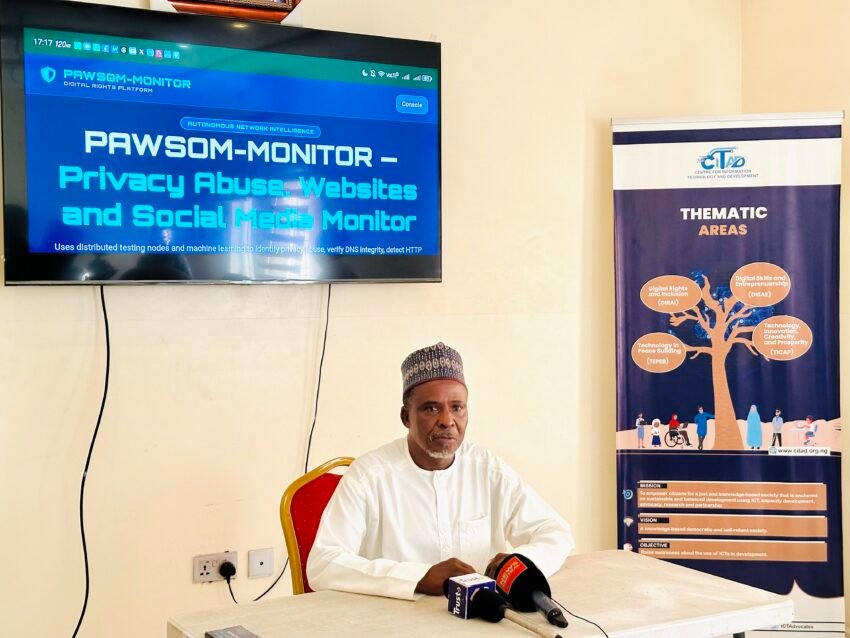
The Centre’s Executive Director, YZ Ya’u raised the concerns and issued to newsmen following a preliminary report generated through PAWSOM-Monitor, an AI-based digital rights monitoring platform launched by CITAD last week to monitor digital access, political parties’ websites, and possible data and privacy breaches before, during and after the election.
According to the report, PAWSOM-Monitor conducted 31,763 checks on the websites of 15 political parties participating in the election between August 8 and 9.
It said 25,287 of the checks were successful, while 6,476 were classified as failed due to technical reasons, with an overall moderate risk ratio of 41/100.
The report further stated that an additional 21,644 checks were conducted on August 12, covering the same 15 political parties.
It noted that the number of parties whose websites were operating with anomalies had increased, with the All Progressives Grand Alliance (APGA) and National Democratic Congress (NDC) joining the affected parties.
CITAD said its preliminary assessment showed that most of the monitored political party websites were accessible and operational during the final verification exercise.
It said 12 political party websites were confirmed operational, while two were classified as operational with anomalies and the website of the Allied Peoples Movement (APM) was classified as unreachable from the monitoring server.
The APM website, according to the report, recorded the most significant concern, as all three verification attempts conducted by PAWSOM-Monitor returned responses associated with an “ISP_block_detected” error.
The website recorded zero successful checks during the period.
However, CITAD cautioned that the finding did not establish that the APM website was deliberately blocked or censored.
It explained that the observation only indicated that the website was unreachable from the monitoring vantage point and required independent verification.
The Peoples Redemption Party (PRP) website was also reported to have recorded significant anomalies.
Although the website was accessible during all three final verification attempts, including independent verification by CITAD monitors, it was classified as “Operational With Anomalies” and recommended for further technical review.
Similarly, the Action Democratic Party (ADP) website was accessible during all three final checks but recorded DNS differences in two attempts, resulting in its classification as “Operational With Anomalies.”
The report also flagged the websites of APGA and NDC as operational with anomalies.
CITAD said the findings indicated instances of website unavailability, degraded performance and DNS anomalies during the monitoring period.
However, it stressed that the available evidence was insufficient to determine whether the conditions were caused by deliberate external interference, Internet Service Provider restrictions, hosting problems, domain configuration issues or other technical factors.
“PAWSOM-Monitor therefore does not classify the observations as confirmed cases of censorship or deliberate digital-rights violations at this stage,” the report stated.
According to CITAD, its methodology requires human review and additional verification before any disruption can be attributed to an external actor.
The organisation consequently recommended that affected political parties, particularly APM, PRP and ADP, conduct immediate technical reviews of their websites and domain/DNS configurations to identify and resolve possible underlying problems.
It further advised the parties to engage their hosting providers, domain registrars and Internet Service Providers where necessary to investigate the observed accessibility and DNS anomalies.
CITAD also recommended that the affected websites undergo independent verification before conclusions are drawn regarding possible external interference.
The organisation said monitoring would continue daily.