

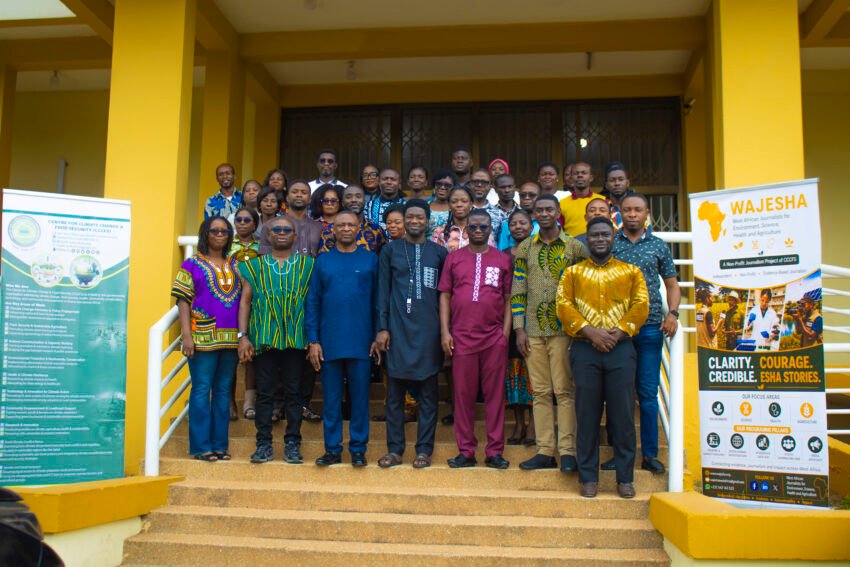
The West African Journalists for Environment, Science, Health and Agriculture (WAJESHA) has urged universities and researchers across Africa to ensure that research benefits society instead of remaining locked away in academic journals.
The call was made during a research communication training organised by the University of Skills Training and Entrepreneurial Development (USTED) in Kumasi, Ghana, in partnership with WAJESHA.
Speaking at the event, USTED’s Pro Vice-Chancellor, Professor Isaac Boateng, said research should not be measured only by the number of publications or citations but by the impact it has on people’s lives.
“Research that is not communicated effectively is knowledge in prison.”
He encouraged researchers to make communication an important part of every research project and to focus on how their findings can improve society.
“Do not measure success only by publication. Measure success by transformation. Do not ask merely, ‘Was my paper published?’ Ask, ‘Whose life changed because of my research?'”
Chairman of USTED’s Publication Board, Dr Christopher Owusu-Ansah, said the workshop addressed a major challenge facing universities in Africa, where valuable research often ends up in international journals that are inaccessible to many people.
“The research that is done is buried behind paywalls.”
He said much of the research conducted by universities is funded with public money and should therefore be shared in ways that improve public understanding, support policymaking and contribute to national development.
To bridge this gap, USTED partnered with WAJESHA, a regional network of journalists dedicated to improving reporting on environment, science, health and agriculture across West Africa.
During the training, WAJESHA facilitators showed participants how to turn academic findings into clear, engaging and accurate news stories without compromising scientific facts.
WAJESHA’s New Media Editor, Daniel Abugri, explained how researchers can identify the news value in their work.
“A study becomes news when people can see how it affects their lives.”
The Director of WAJESHA, Mahmud Mohammed-Nurudeen, led another session on writing research in a style that journalists can easily understand and publish.
“Researchers often write excellent studies but fail to explain why their findings matter to ordinary people.”
The final session focused on adapting research for television, radio and digital platforms. It was facilitated by Mahmud Mohammed-Nurudeen, Daniel Abugri and independent film producer Afrifa Smith Charles.
The workshop brought together researchers, lecturers and university administrators to learn how to present academic research through newspapers, radio, television and digital media using simple language that ordinary people can understand.