

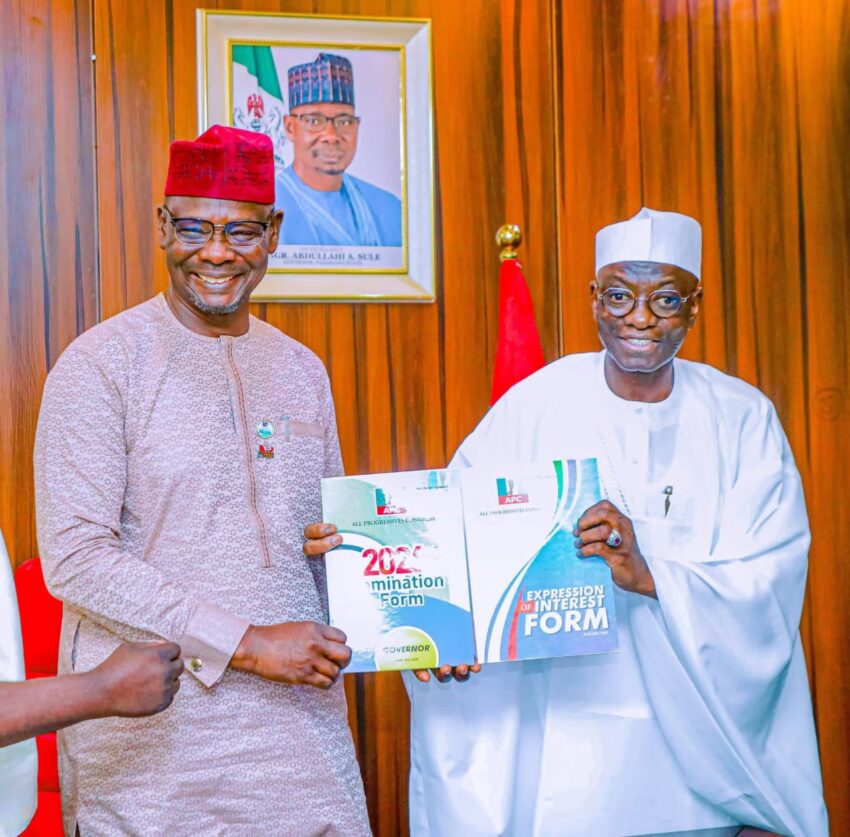
Senator Wadada: Why Governor Sule’s Endorsement Is Not imposition
By Ali Abare
There is a certain kind of political noise that does not come from genuine grievance but from the frustration of those who already know, even before the race begins, that they have little chance of winning it.
That noise is now loud in Nasarawa State, where a section of the media, clearly doing the bidding of some governorship aspirants on the fringes of the 2027 contest, has been pushing the story that Governor Abdullahi Sule is imposing Senator Ahmed Aliyu Wadada on the All Progressives Congress as its governorship candidate.
This is a claim that falls apart the moment you hold it up against the facts.
Governor Sule himself has been clear about how he arrived at his decision. The process took over a year and involved consultations far beyond the borders of Nasarawa State.
He spoke with foreign and prospective investors, youth groups, women’s organisations, traditional rulers, party officials, and stakeholders from across the state’s three senatorial zones.
A governor who wants to impose a candidate does not go through all that trouble. He simply picks a name and moves on. Governor Sule did the opposite.
He was also careful about how he presented the outcome. He told his appointees publicly that his choice of Senator Wadada was not a verdict that the other aspirants were inferior. He warned them against mocking those who were not selected.
He even acknowledged that any of the three aspirants on his final shortlist could have won a general election. The field was narrowed only after further rounds of consultation. That is not how imposition works. That is how a responsible political leader manages succession.
The question that those crying imposition have refused to answer is a simple one: who is Senator Ahmed Aliyu Wadada, and what has he done to earn the standing he holds today in Nasarawa politics?
His political career started in 2003 when the people of Karu/Keffi/Kokona Federal Constituency voted him into the House of Representatives.
They liked what they saw and returned him for a second term.
He has since moved up to the Senate, where he now represents Nasarawa West Senatorial District.
That is more than two decades of continuous electoral engagement — two decades of building support, earning trust, and showing up for people across a state that is not easy to navigate politically.
In the 2019 APC governorship primary, he came second. Nobody gave him that. He earned it through the grassroots network he had quietly built over the years.
He holds the traditional titles of Sarkin Yakin Keffi and Magajin Dangin Lafian Barebari — honours that communities in Nasarawa do not hand out casually.
His political relationships cut across ethnic, religious, and geopolitical lines in ways that none of the aspirants now raising dust can honestly claim to match.
Most of those aspirants have never contested and won even a councillorship position. Their ambitions may be genuine, but they have no political structure to speak of and no record of service that comes close to what Senator Wadada has put on the table over two decades.
The support that has gathered around him makes the imposition argument even harder to sustain.
When Senator Wadada went to submit his expression of interest and nomination forms, all 13 local government council chairmen in Nasarawa State showed up.
So did the full membership of the State House of Assembly, from the Speaker down to the ordinary members. No governor has the power to order independent-minded politicians to show up like that. Those men and women made their own calculations and reached their own conclusions.
The Majority Caucus of the House of Assembly, led by Speaker Danladi Jatau, formally declared its support for Wadada and called on other aspirants to close ranks behind him for the good of the party.
When a candidate pulls that kind of support together, the word imposition simply does not apply.
The endorsement has also come from beyond Nasarawa. Vice President Kashim Shettima, speaking at the Nasarawa Investment Summit 2026, told the gathering openly that he expected Senator Wadada to succeed Governor Sule and keep the state’s development momentum going.
He looked directly at the senator and said: “Senator Wadada, you have your job cut out for you.” A Vice President does not say that sort of thing in public without meaning it. It is a clear signal from the national leadership of the party that Wadada is the right man at the right time for Nasarawa.
Senator Wadada has also shown the kind of character that the moment calls for. He has said publicly that he cannot do this alone and has reached out to his fellow aspirants, promising to consult each of them and asking for their support in the interest of the state.
A candidate who was imposed on the party would not bother doing any of that. He would have nothing to prove. The fact that Wadada is doing the hard work of reconciliation says something about both his confidence and his character.
Those alleging imposition have not been able to name a rival aspirant with a stronger political record, a wider structure, or deeper acceptance across Nasarawa communities. All they have offered is complaint — and complaint is what you resort to when you know you cannot win a fair contest on your own merits.
Their frustration is human. But frustration is not the same thing as injustice.
Governor Sule looked at the field, studied the candidates, weighed their structures, assessed their acceptance across the state, and decided that Senator Wadada gave the APC the best chance of holding power in 2027.
The deputy governor, Dr. Emmanuel Akabe, the party chairman, Dr. Aliyu Bello, the legislature, and the Vice President of Nigeria all looked at the same picture and reached the same conclusion on their own.
That is not imposition. That is the political community of Nasarawa State speaking with one voice — and that voice has been earned, not manufactured.