

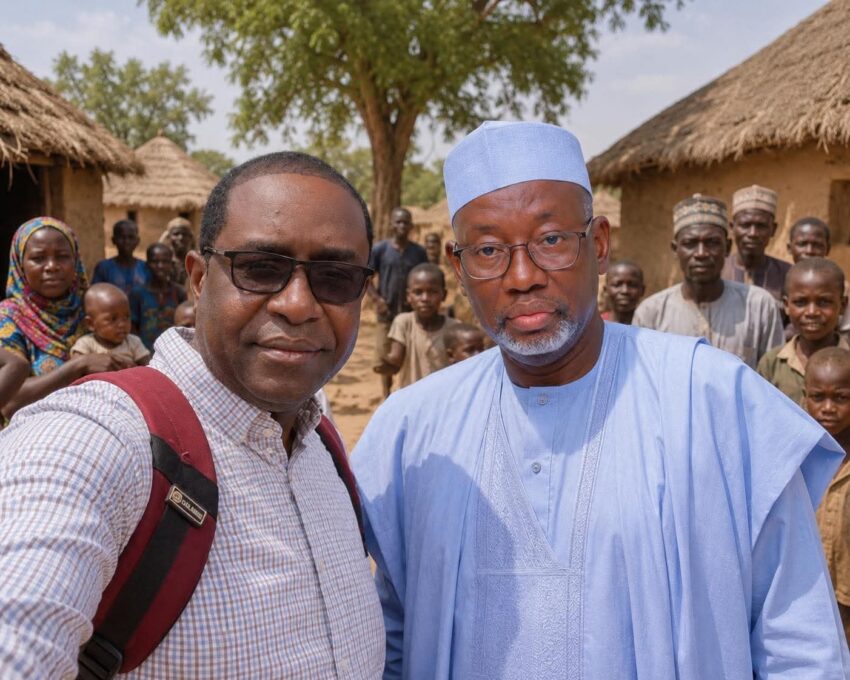
By Musa Abdullahi Sufi
Across Nigeria, citizens have become increasingly skeptical of grand declarations and campaign rhetoric. What many now seek are leaders whose actions speak louder than speeches, leaders who can translate public trust into tangible improvements in people’s lives.
Three years after assuming office as Governor of Jigawa State, Malam Umar Namadi has steadily built a reputation around that principle. His administration has attracted attention not because of political drama or media spectacle, but because of a deliberate focus on development, fiscal discipline, social inclusion, and grassroots engagement.
In a country where many states continue to struggle with unemployment, insecurity, poor infrastructure, and declining social services, Jigawa’s experience offers an interesting story. It is the story of a state attempting to chart a different course through careful planning, prudent management of resources, and sustained investment in people.
For many residents, the most remarkable aspect of the Namadi administration is not any single project or policy. It is the sense of direction that has emerged over the past three years. In politics, promises are easy. Governance is not.
Leadership Anchored on Humility and Prudence
Those who have followed Umar Namadi’s public service journey often point to two qualities that have defined his leadership style: humility and financial discipline.
Before becoming governor, he built a reputation as a technocrat with extensive experience in finance and public administration. That background appears to have influenced his approach to governance.
When he took office, Nigeria was facing significant economic turbulence. Rising inflation, declining purchasing power, climate-related challenges, and growing demands for social services placed enormous pressure on state governments across the country.
In Jigawa, the response was not reckless spending or headline-driven projects. Instead, the administration adopted a cautious approach centered on strategic budgeting, accountability, and value-for-money investments.
The result has been the simultaneous execution of projects across multiple sectors without creating the impression of fiscal chaos. Roads are being constructed, schools upgraded, healthcare facilities improved, and agricultural investments expanded while maintaining a strong emphasis on prudent resource management.
In an era when public confidence in government spending is often low, this approach has earned the governor a reputation as a careful steward of public resources.
Turning Agriculture into an Economic Strategy
Agriculture remains the backbone of Jigawa’s economy, employing thousands of families and sustaining rural communities.
Governor Namadi’s administration appears to understand that any meaningful transformation of the state must begin with the sector that feeds its people and drives much of its economy.
Over the past three years, the government has invested heavily in agricultural support programs. Farmers have benefited from fertilizer subsidies, improved seeds, mechanization initiatives, access to tractors, and other interventions designed to boost productivity.
Yet the administration’s vision goes beyond simply increasing crop yields. The broader goal appears to be transforming agriculture into a catalyst for economic growth, job creation, and industrial development.
Investments in agricultural value chains, agro-processing opportunities, and local production initiatives reflect an understanding that agriculture can generate wealth not only on farms but also through processing, transportation, storage, and marketing.
For many communities across Jigawa, these interventions have provided renewed optimism that agriculture can once again become a pathway to prosperity rather than merely a means of survival.
Building Peace Between Farmers and Herders
One of the most complex challenges confronting Northern Nigeria remains the recurring conflict between farmers and herders. These disputes have often resulted in loss of lives, destruction of livelihoods, and deep social divisions.
Rather than relying exclusively on security responses, the Namadi administration has pursued a more comprehensive strategy. The government has invested in dialogue, mediation, grazing management, livestock development, and community engagement.
In several communities, local disputes that could have escalated into violence were resolved through consultations involving traditional leaders, farmers, pastoralists, and government officials.
Equally important are the structural measures being introduced, including the development of grazing reserves, livestock support initiatives, and improved access to water resources.
These efforts recognize an important reality: sustainable peace cannot be achieved merely by responding to conflicts after they occur. It requires addressing the underlying causes of those conflicts.
In a state where agriculture remains central to economic life, maintaining harmony between farmers and pastoralists is not simply a security objective, it is an economic necessity.
Investing in Education, Investing in the Future
Education occupies a central place in the administration’s development agenda. Across Jigawa, school infrastructure has received significant attention. Classrooms have been renovated, new facilities constructed, and efforts intensified to improve learning conditions.
The recruitment of teachers and support for tertiary institutions reflect a broader commitment to strengthening the education sector. Particularly noteworthy is the emphasis placed on girl-child education.
In many parts of Northern Nigeria, barriers continue to limit educational opportunities for girls. Through scholarships and targeted interventions, the administration has sought to address some of these challenges and encourage greater participation.
These investments are about more than school enrollment figures. They represent an attempt to equip a new generation with the knowledge and skills needed to compete in an increasingly complex world.
No society can achieve lasting development while neglecting education, and Jigawa’s current trajectory suggests a recognition of that fundamental truth.
Strengthening Healthcare Where It Matters Most
Healthcare remains one of the clearest indicators of government commitment to human development. Over the past three years, the Namadi administration has directed considerable attention toward improving healthcare infrastructure and service delivery.
Primary healthcare centers have received upgrades, while efforts to improve maternal and child health services have continued across the state.
These investments may not always generate dramatic headlines, but they often have the most direct impact on ordinary citizens.
For pregnant women seeking safer deliveries, children requiring immunization, or rural families needing access to basic medical care, functional healthcare facilities can make the difference between vulnerability and security.
The administration’s focus on healthcare reflects an understanding that economic progress means little if citizens cannot access quality medical services.
Women as Partners in Development
Development is most effective when it includes everyone. His administration has introduced several initiatives aimed at expanding economic opportunities for women through grants, vocational training, entrepreneurship support, microcredit programs, and other empowerment schemes.
These interventions recognize women not merely as beneficiaries of government policies but as contributors to economic growth and community development.
Across rural and urban communities alike, women continue to play critical roles in commerce, agriculture, education, and family welfare. And supporting their economic participation strengthens households and ultimately strengthens society itself.
Creating Opportunities for Young People
Jigawa’s youthful population represents one of its greatest strengths. It also represents one of its greatest responsibilities. Like many parts of Nigeria, the state faces the challenge of creating opportunities for a growing number of young people entering the labor market each year.
The administration has responded through various empowerment programs focused on skills development, entrepreneurship, vocational training, and employment support.
The establishment of youth-focused institutions and programs reflects a recognition that sustainable development requires investing in the next generation. For many young people, such initiatives offer alternatives to unemployment, frustration, and social exclusion.
Bringing Development Closer to Rural Communities
Perhaps one of the most visible aspects of the administration’s work is its emphasis on rural development. In many states, development tends to concentrate around major urban centers while rural communities remain neglected. Jigawa’s approach has sought to reduce that imbalance.
Road construction, water projects, school upgrades, healthcare facilities, and other infrastructure investments have extended beyond major towns into communities where such interventions are often needed most.
For residents of these areas, development is not measured by policy documents. It is measured by roads that connect villages to markets, healthcare centers that provide treatment, schools that educate children, and water projects that ease daily hardship.
Modernizing Government for a New Era
Another important aspect of the Namadi administration is its effort to improve governance through technology and institutional reforms. Although these changes may be less visible than roads or buildings, they are equally important.
A more efficient public service can improve service delivery, strengthen accountability, and create a better environment for economic growth. As technology continues to reshape governance around the world, states that embrace innovation are often better positioned to meet the demands of modern development.
Governing Through Engagement
One quality that repeatedly emerges in discussions about Governor Namadi’s leadership is accessibility.
Through visits to communities, consultations with stakeholders, and engagement across local government areas, the administration has maintained a close connection with citizens.
This approach allows government decisions to be informed by realities on the ground rather than assumptions made from distant offices.
It also reinforces a simple but powerful principle: governance works best when people feel heard.
The Challenges Have Been Real
The story of the past three years would be incomplete without acknowledging the difficulties. Jigawa continues to face challenges associated with poverty, unemployment, climate change, educational deficits, infrastructure needs, and broader national economic pressures.
The governor did not inherit a perfect state, nor has every challenge disappeared. However, supporters argue that the administration’s ability to sustain development efforts despite these constraints demonstrates resilience and strategic thinking.
Many residents see the relative stability recorded during this period as evidence of a government focused on solutions rather than excuses.
Why Many Are Talking About Continuity
As political conversations increasingly turn toward the future, many supporters argue that the reforms initiated over the past three years require continuity. Large-scale transformations rarely happen overnight.
Agricultural reforms need time to mature. Educational investments often take years before their full impact becomes visible. Infrastructure projects generate benefits over decades rather than months.
For those who support the administration, the argument for continuity is therefore less about politics and more about completing an ongoing development journey.
A Model Worth Paying Attention To
Three years into office, Umar Namadi’s administration has gradually built a development narrative rooted in inclusion, stability, human capital development, agricultural transformation, and responsible governance.
His leadership style suggests that meaningful progress does not always come through dramatic announcements or political theatrics. Sometimes it comes through consistency, listening, the difficult work of building institutions, empowering communities, and creating opportunities for future generations.
From the farms of rural Jigawa to classrooms, healthcare centers, roads, and community development projects across the state, the administration has sought to demonstrate that governance can still be purposeful and people-centered.
Whether history ultimately judges this period as transformational, will be left to future generations. What is clear, however, is that the first three years of Governor Umar Namadi’s administration have provided a compelling example of how vision, discipline, and commitment can begin to reshape the fortunes of a state and strengthen the confidence of its people in the promise of democratic governance.