

Reviewed by Gabriel Ebiere Blessing
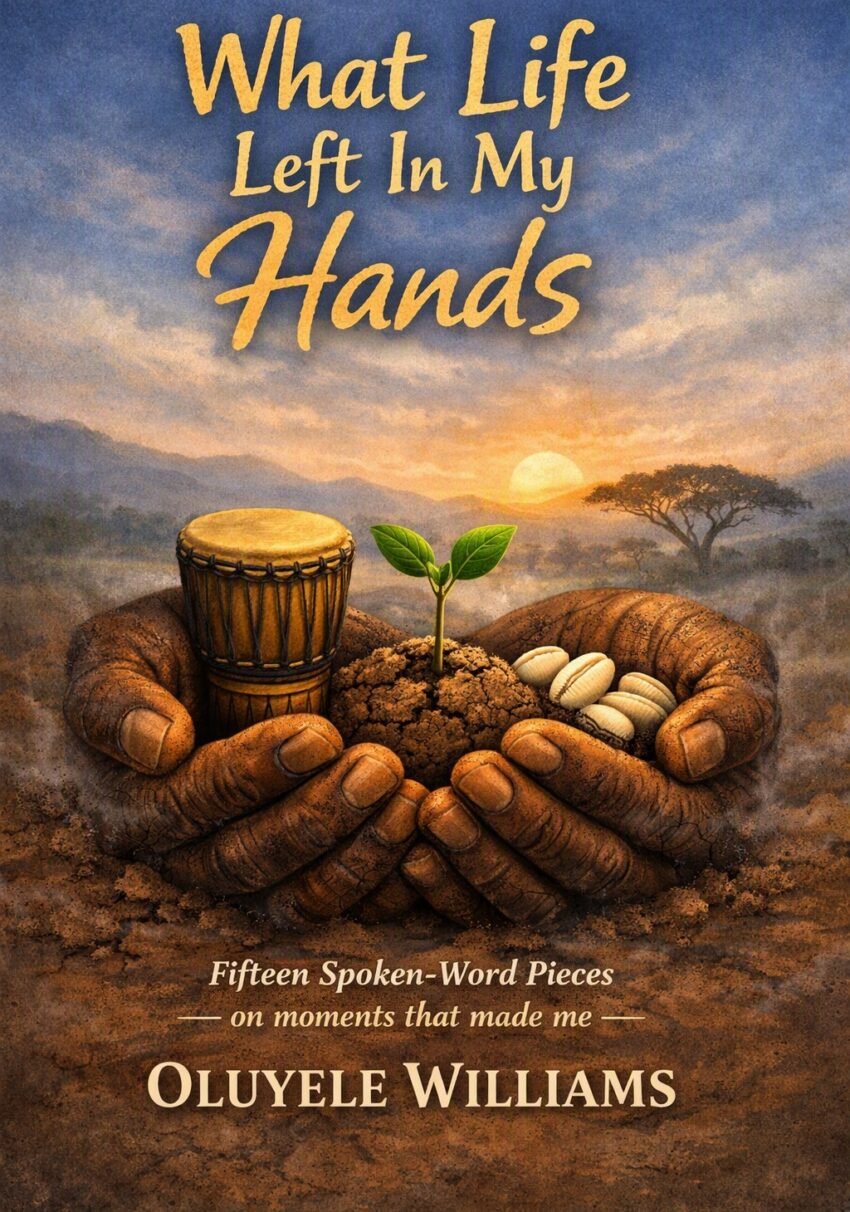
Some books are written to preserve experiences; others attempt to make meaning of them. In What Life Left in My Hands, Oluyele Williams undertakes both tasks, transforming personal memories into fifteen spoken-word pieces that explore grief, ambition, betrayal, injustice, resilience, and the often-unpredictable consequences of human choices. Subtitled Fifteen Spoken-Word Pieces on Moments That Made Me, the collection invites readers into the experiences that have shaped its author while asking a broader question: what remains of a person after life has taken away the things once considered indispensable?
Williams approaches this question through autobiographical storytelling, drawing from educational struggles, family loss, professional disappointments, migration, and encounters with human generosity. The result is a collection that finds its strongest moments not in the declaration of triumph but in the examination of what it costs to continue living, hoping, and believing.
The Architecture of Personal Experience
The collection’s greatest strength lies in its narrative coherence. Although the fifteen pieces address different experiences, they are connected by a recognizable pattern of consciousness: that of a person looking backward to understand the forces that shaped him. In “When Hope Knocked,” admission into the University of Ibadan becomes more than an academic achievement. It represents the convergence of personal determination, family sacrifice, and collective aspiration. By invoking JAMB and WAEC, Williams grounds his narrative in the familiar realities of Nigerian education, where examination results and admission letters can carry consequences far beyond the classroom. The poem’s emotional significance emerges from this understanding of education as both an opportunity and a responsibility.
The collection becomes more affecting, however, when success gives way to loss. “A House Without Roots” is among its most emotionally compelling pieces. Williams describes his parents as the pillars of the family’s domestic world before confronting the devastation of losing them. The image of a house that remains standing after losing its foundations captures grief with admirable economy. The physical structure survives, but its meaning has been altered. This metaphor demonstrates Williams’s ability to translate personal sorrow into an image that readers can inhabit. Rather than relying entirely on emotional declarations, he allows the architecture of the house to represent the architecture of family life. It is a persuasive example of metaphor serving the emotional and intellectual demands of a poem.
Between Resilience and Reflection
Across the collection, Williams repeatedly examines the relationship between hardship and personal growth. “Crowned by the Climb” and “Fifteen Pounds of Tomorrow” explore perseverance through different circumstances, while “When Courage Forgot Me” considers the loneliness that can accompany private struggles. The account of arriving in Manchester with fifteen pounds and no accommodation provides one of the collection’s clearest narrative arcs. The eventual achievement of a master’s degree with distinction establishes a satisfying contrast between the uncertainty of the beginning and the accomplishment that follows. Yet, the poem’s more valuable insight is that courage does not necessarily mean confidence. Sometimes, it means taking the next step without knowing whether circumstances will improve. This distinction prevents resilience from becoming merely motivational rhetoric.
Nevertheless, the collection occasionally explains lessons that its narratives have already communicated effectively. Certain endings restate the central message in language that leaves little interpretative work for the reader. While this approach can strengthen a spoken-word performance, it may reduce the subtlety expected of a literary poem. The collection is most effective when Williams trusts the experience itself to carry its meaning. His strongest images often communicate more than an additional paragraph of explanation could achieve.
Betrayal, Injustice, and the Social World
Williams’s attention to interpersonal disappointment broadens the collection beyond private reflection. In “The Snake I Sheltered,” betrayal challenges the assumption that generosity necessarily produces loyalty. “Justice Never Called” examines a different kind of disappointment: an academic experience in which a student’s correct answers fail to secure a fair outcome. The latter poem begins with a striking contradiction:
“My script said I had passed. / The result said I had failed.”
The directness of these lines establishes the conflict immediately. The opposition between the script and the result becomes a confrontation between evidence and authority, exposing the vulnerability of individuals within systems that do not always correct their own mistakes.
These experiences resonate with familiar social realities, particularly where institutional power can outweigh personal evidence. However, the poem would benefit from a greater exploration of its emotional and psychological implications. The injustice is clearly narrated, but the literary treatment could go further in examining how such an experience alters the speaker’s understanding of fairness, authority, or self-worth. “Another Man’s Storm” similarly demonstrates the collection’s interest in the difference between visible circumstances and invisible suffering. Its account of delayed wages, family separation, and the withdrawal of friends challenges the tendency to interpret hardship as personal failure. Williams’s assertion that changed circumstances do not diminish human worth is both humane and socially relevant.
Language, Form, and the Spoken-Word Tradition
Williams writes predominantly in free verse, using short lines, deliberate pauses, repetition, rhetorical questions, and conversational phrasing. These features make the collection accessible and suggest a strong awareness of performance. The poems are constructed to be heard as much as read, with moments of emphasis that could acquire considerable force through vocal delivery. His language is generally clear, and his imagery frequently emerges from ordinary objects and situations: a letter, a house, a school hall, a list of textbooks, or a small amount of money. This everyday vocabulary gives the experiences credibility. The poems do not depend on elaborate diction to establish emotional significance.
However, accessibility should not be confused with artistic simplicity. The strongest spoken-word writing combines clarity with discovery, allowing familiar experiences to produce unfamiliar insights. At times, Williams relies on recognizable inspirational formulations and repeated statements of his conclusions. More varied imagery, tighter compression, and a greater willingness to leave certain meanings unstated would strengthen the collection’s literary distinction. Repetition remains a useful device, but its effectiveness depends on development. When repeated phrases intensify an emotion or change meaning through context, they create rhythm and emphasis. When they merely reiterate an established point, they risk becoming redundant. A more rigorous editorial approach could preserve the collection’s performative energy while improving its precision.
English, Punctuation, and Editorial Precision
The collection’s language is largely intelligible, and its free-verse structure makes unconventional line breaks a legitimate stylistic choice. Consequently, not every short sentence or isolated phrase should be treated as a grammatical error. Nevertheless, artistic freedom does not eliminate the need for careful proofreading.
One noticeable issue appears at the conclusion of “A Seat Among Stars,” where the word “no” appears after a sentence ending in “a meal.” This looks like a possible stray word and should be checked against the author’s intended text. The acknowledgements also contain the phrase “I will like to appreciate.” In standard formal English, “I would like to thank” or “I would like to express my appreciation to” would be more appropriate. Additionally, the author’s biographical note refers to the collection as What Life Left in My Hand, whereas the cover title is What Life Left in My Hands. This inconsistency should be corrected for bibliographic accuracy. Capitalization and title presentation would also benefit from a consistent editorial style. Such issues are not merely cosmetic; they influence the professionalism of the finished publication and the reader’s confidence in the text. A thorough copy-editing and proofreading pass would address these concerns without interfering with the author’s individual voice.
Final Assessment
What Life Left in My Hands is a sincere and accessible collection built around the conviction that experience, including painful experience, can become a source of understanding. Its autobiographical foundation gives the poems credibility, while its recurring concerns with family, education, resilience, and human dignity provide thematic unity. Williams’s principal achievement is his willingness to revisit difficult experiences without allowing the narrative to end in despair.
His principal limitation is a tendency to explain conclusions that his imagery and storytelling have already established. Greater compression, more layered symbolism, and sharper editorial control would make the collection more artistically compelling. Ultimately, the book’s value lies in its recognition that a life cannot be measured exclusively by what it loses or acquires. What remains—memory, character, lessons, and the capacity to continue—may be equally consequential. In documenting these remnants, Oluyele Williams offers readers not a flawless literary achievement, but a thoughtful and promising meditation on the experiences through which a person becomes who he is.
Gabriel Ebiere Blessing is a Nigerian writer, literary critic, and spoken-word artist whose work interrogates the complexities of human existence, faith, identity, and the delicate intersections between personal experience and collective realities. Her writing is characterised by emotional depth, contemplative inquiry, and a keen sensitivity to the unspoken narratives that shape human lives. Her work reflects a sustained interest in the transformative possibilities of words and their capacity to deepen human understanding.